Thursday, December 19, 2013

San Jose Bag Ban one and half year later what is there bragged about "success"

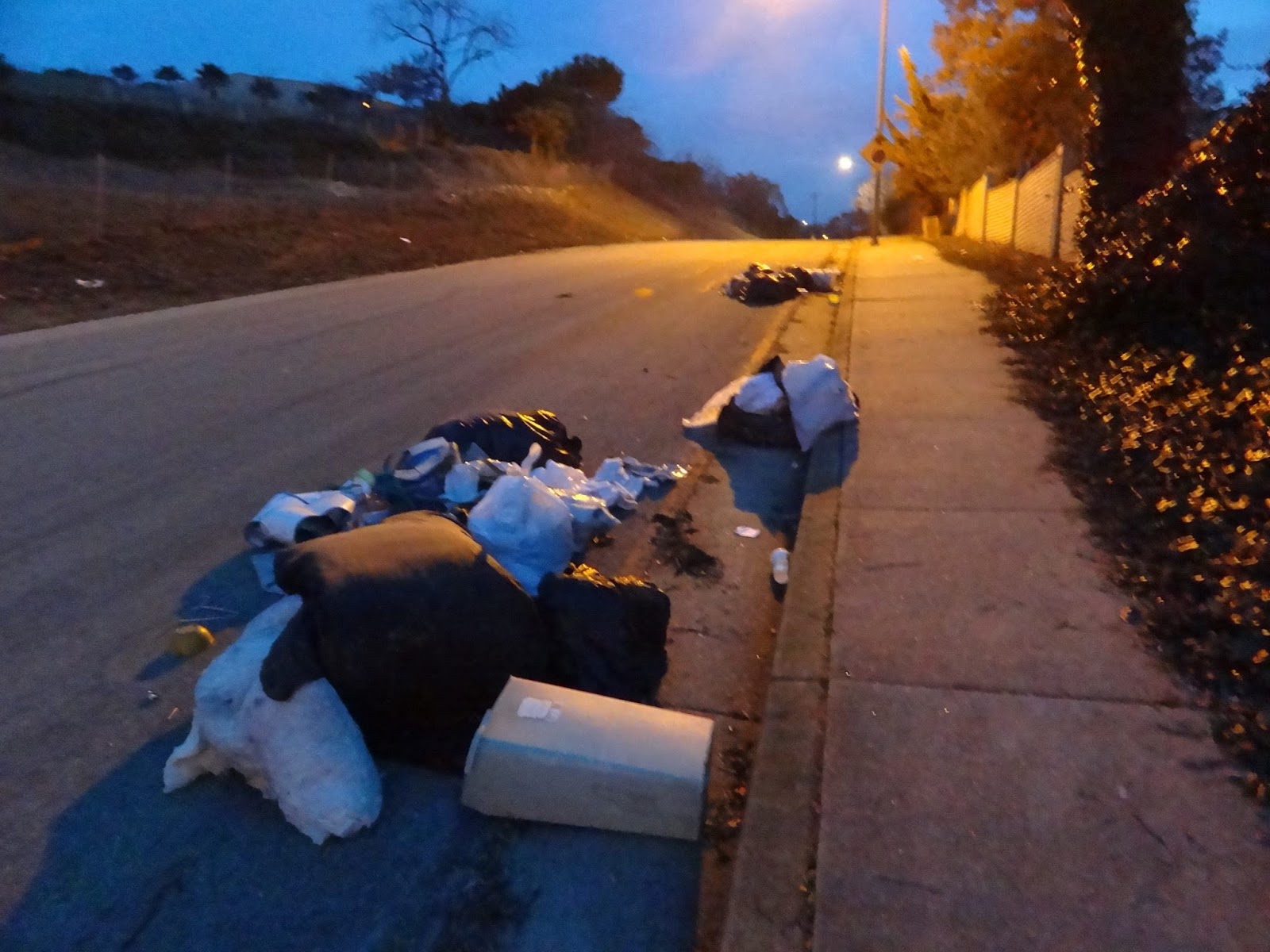
This is a common sight all around San Jose, large amounts of junk alongside road, largest being a broken doghouse 
San Jose Bag Ban one and half year later define "Success"

This is a common sight all around San Jose, large amounts of junk alongside road, largest being a broken doghouse 
The controversial ban on plastic and free paper shopping bags had drawn a lot of negative public reactions. There has been notable shift to shopping elsewhere for city residents. Of course this is denied by those pushing for these bans. Though a year later through a city report concludes the ban is successful however the question is what do they define success?


North Capital Expressway onramp trashed shoulders Dec 11 2013
Reduction of litter in the city, reducing urban blight, less trash on the streets? From my observations and through photographic evidence it appears non of it is the case at least in San Jose.


Taking trips around the city I noticed that streets gutters, empty lots and creek beds are still littered by mountains of garbage including plastic film that resemble plastic bags. As well as plenty of paper and other hazardous trash.

These pictures below are taken in Las Palmas Ave between King Road and Educational Park Dr. near Independence High School August 26, 2013


August 26, 2013 on Las Palmas Ave. This is a common sight all around San Jose, large amounts of junk alongside road, largest being a broken doghouse 

More garage at least some are bagged preventing it from spreading. 


Pieces of paper, plastic, and clothing

Large amounts of trash beside parked car

large amounts of plastic fast food cups alongside gutter 
Wood board covering large amount of  takeout related trash

This is a common sight all around San Jose, large amounts of junk alongside road, largest being a broken doghouse 

Hubcap along with many trash

large amounts of paper and plastic and other trash of all types at gutter alongside van.

These will all end up in the storm drain and where ever it drains to if a rain storm pours
This is on Murillo Ave around were I live, I photographed the area between Quimby Rd and Grosbeck Hill Park

All photos taken January 22, 2013
Trash along side springbrook Ave. Appears to have fallen out of the garbage truck at least that ones bagged and not all over the place

Random pack of trash along Murillo ave.  
Random trash along Murillo ave


Sidewalk Murillo Ave. where it ends up at Grosbeck park 
Fast food  wrapper

 Tires and bag of trash and other rubbish


This stretch of Murillo Ave between Norwood av/Mt Pleasant Road and Tully Ct, Murillo for some unknown reason back in the 1990s had been configured to dead end 2000 feet to the north. The configuration leads this secluded stretch to often become a hot spot for residential dumping 

Fortunately this dumper did bag his garbage preventing the mess from spreading and easing cleanup 


This signs although common around the city means pretty much nothing and often  its surrounded by a sea of garbage. 
Capital Expressway between Quimby rd and Aborn Ave
July 2013
 Random Bag along Capital Expressway isn't this what the ban is supposed to prevent
bag ban does nothing to stop such issue
Shopping cart from Walgreens in Evergreen Village Square two miles down hill pushed this far from the store miles up a hill between Quimby Rd and Murillo Ave. actually I bet this would cost supermarkets and stores big bucks to retrieve them.  

Is this what we call Success? 

Now I wonder what is the success supposed to mean? Stores profiting from bag ban. People, homeless or otherwise, using unhygienic reusable bags with spoiled spills and even insects in them, increased shoplifting that requires stores to add chains between the check stands, people dropping groceries in the parking lots and leaving them there, paper bags breaking on their way out of the checkout counter? Consumer buying similar yet larger bags for every day needs for plastic bags instead of reusing store bags, rude cashiers becoming ruder, unbagged  garbage blowing around the wind like confetti?   In the end it is all liberal facist scheme to change behaviors not actually to improve the environment. We the people say repeal it or at least put it unto public vote. 

Wednesday, August 28, 2013

San Jose Bag Ban one and half year later what is there bragged about "success"

This is a common sight all around San Jose, large amounts of junk alongside road, largest being a broken doghouse 
San Jose Bag Ban one and half year later define "Success"

This is a common sight all around San Jose, large amounts of junk alongside road, largest being a broken doghouse 
The controversial ban on plastic and free paper shopping bags had drawn a lot of negative public reactions. There has been notable shift to shopping elsewhere for city residents. Of course this is denied by those pushing for these bans. Though a year later through a city report concludes the ban is successful however the question is what do they define success?

Reduction of litter in the city, reducing urban blight, less trash on the streets? From my observations and through photographic evidence it appears non of it is the case at least in San Jose.


Taking trips around the city I noticed that streets gutters, empty lots and creek beds are still littered by mountains of garbage including plastic film that resemble plastic bags. As well as plenty of paper and other hazardous trash.

These pictures below are taken in Las Palmas Ave between King Road and Educational Park Dr. near Independence High School August 26, 2013


This is a common sight all around San Jose, large amounts of junk alongside road, largest being a broken doghouse 

More garage at least some are bagged preventing it from spreading. 


Pieces of paper, plastic, and clothing

Large amounts of trash beside parked car

large amounts of plastic fast food cups alongside gutter 
Wood board covering large amount of  takeout related trash

This is a common sight all around San Jose, large amounts of junk alongside road, largest being a broken doghouse 

Hubcap along with many trash

large amounts of paper and plastic and other trash of all types at gutter alongside van.

These will all end up in the storm drain and where ever it drains to if a rain storm pours
This is on Murillo Ave around were I live, I photographed the area between Quimby Rd and Grosbeck Hill Park

January 22, 2013
Trash along side springbrook Ave. Appears to have fallen out of the garbage truck at least that ones bagged and not all over the place

Random pack of trash along Murillo ave.  
Random trash along Murillo ave


Sidewalk Murillo Ave. where it ends up at Grosbeck park 
Fast food  wrapper

 Tires and bag of trash and other rubbish


This stretch of Murillo Ave is often a hot spot for residential dumping

Fortunately this dumper did bag his garbage preventing the mess from spreading and easing cleanup 


This signs although common around the city means pretty much nothing and often  its surrounded by a sea of garbage. 
Capital Expressway between Quimby rd and Aborn Ave
July 2013
 Random Bag along Capital Expressway isn't this what the ban is supposed to prevent
bag ban does nothing to stop such issue
Shopping cart pushed this far from the store miles up a hill actually I bet this would cost supermarkets and stores big bucks to retrieve them.  

Is this what we call Success? 

Now I wonder what is the success supposed to mean? Stores profiting from bag ban. People, homeless or otherwise, using unhygienic reusable bags with spoiled spills and even insects in them, increased shoplifting that requires stores to add chains between the check stands, people dropping groceries in the parking lots and leaving them there? Consumer buying similar yet larger bags for every day needs for plastic bags instead of reusing store bags, rude cashiers becoming ruder, unbagged  garbage blowing around the wind like confetti?   In the end it is all liberal facist scheme to change behaviors not actually to improve the environment

Monday, August 12, 2013

Cost of telecommunications is it really getting more expensive than around twenty years ago?


Cost of Telecommunications (Cable TV, phone, Internet)? Is todays household telecommunications bill it more expensive than it was during the 1990s?

This is not exactly Politics and bureaucracy related post although it is likely to be affected by politics and bureaucracy. The issue with the rising cost of telecommunications where most modern people depend on.

I know most of us would just see our bills keep rising year after year. Cable companies increasing guage customers using various excuses such as high prices the networks are charging them which many customers argue that their satellite competitors did not raise rates and that cable is just being monopolistic as they usually have no competition in their area. While most could choose Satellite instead nowadays it could be out of the questions for those who live where tall trees or buildings block the view to the sky. Nowadays companies charge extra for pretty much modern day essentials such as HD receivers and DVRs. Which is pretty much a necessity for those with High Definition television sets(which poorly display standard definition signals in a much smaller display area or distorted) with digital receivers who may want to record shows for later watching which was once done free with a VCR in the past which is now out of the option. Today it is not uncommon for tv only rates to exceed $60 a month plus the additional rates around $10 for HD DVR and extra television set rates. Today most people would also need in addition to cable tv; Internet Access or phone service. These days cable tv and phone companies often provide both television, Internet, and phone together for bundled rates.

Though we wonder are things really overpriced compared to the good old days? We can try to compare modern rates with the rates we used to pay back in the early 1990s which is pretty much twenty years ago.  While its true that Standard basic Cable tv bills used to be lower(Around $25 a month) of course not adjusting for inflation and cost of goods and having only 50 channels if not less, home phone bills as well as Internet ISP bills were actually higher in terms of use. In the early 1990s before phone service competition price wars it is not uncommon for phone companies to charge long distance for calls to the next county or even city and the line between local calls and long distance calls were pretty blurry. Long Distance is often charged by the distance starting from 0.15 a minute for the closest area they charge for and go up from there with calls across the country costing over 50 cents a minute and for International calls between $1-$4 a minute depending on destination and hours of call. It was not uncommon for average family phone bills to run over $200 a month. As for Internet the early Internet service providers or ISPs often charged dial up Internet by the minute and or the hour.  The rate was often around $0.05 a minute or $1-$3 a hour which can get expensive for those using it for hours a day. For example those who use an average of two hours a day would see their rates between $60-$120 a month. That is if the dial up access number is actually within the local boundary set by the phone company otherwise long distance charges would also accrue which is an issue with many out of the way residences or businesses where there are no local isp phone numbers. Remember these rates are all in early 1990s dollars therefore adjusted for inflation and price of good and services with today's dollar the rates would pretty much equal to double the figures in 1990s dollars.

So now we wonder are we being ripped off today by the companies? Are we paying more or less? I would do a comparison. I will also do a optional factor in the use of cell phones nowadays.

1993
Landline Phone bill(based an average charge of .70 a minute of mixed use long distance calling for 250 minutes a month $175
Dial up ISP $2 a hour for average 2 hours use a day in a thirty day period $120
Standard basic Cable TV $25around 45 channels
total= $320(in 1993 US dollars)
It is assumed most residents would not had cell phones back in 1993 the few that do contend with enormous rates.
2013
Comcast Cable tv, phone, Internet rates. Normal(not promotional) rates $122 for digital starter with 80 channels with phone and Internet.
Comcast Digital preferred with 160 channels HD DVR, upgraded Internet, and phone normal rates $169
optional cell phone inclusion as most families in 2013 have cell phones for each family member: Cell phone i.e AT&T $50 each for unlimited talk and Data a family of four is $200.
total=
no cell phone: $122 for starter, $169 for preferred bundle customers
with smart cell phone: $322 for starter, $369 for preferred.
Remember I did not adjust for the cost difference between 1993 dollars and 2013 dollars. Therefore in today's dollars the 1993 rates, well you can do the math. 

Tuesday, July 23, 2013

Places that still respect individual choices aka freedom


nanny-state.jpg

Today's fascist Nanny state liberals are just completely out of control. With the help of the Internet and more advanced communications they are able to bribe almost every governmental organization ranging from countries to townships including Homeowners/apartment Associations or HOAs around the world to make frivolous legislation after legislation banning items or regulating individual lives. These legislation are often just knee jerk feel good measures only serve to clog up the legal system and distracts the attention of governments from more important matters and actually costs a lot of money which might explain what's with the spending and deficit. Also it makes everyone feel guilty just living their lives its getting increasingly difficult to near impossible to avoid violating a vaguely written statue or ordinance just living their everyday lives. Also it gives officers more opportunities for profiling. While California and New York are often known for being "Nanny States" these issues are not limited to there. In fact even New Hampshire despite having the motto of  live free or die is not immune from liberal fascism now they have forms of helmet laws and number of other laws pushed by activists.

<iframe width="560" height="315" src="//www.youtube.com/embed/Hdu5IKD6loY" frameborder="0" allowfullscreen></iframe>

Based on my research  I have a list of places that still value individual choice. Which stands individual right to choose and be responsible for their own actions as long as it does not interfere with the rights of others. Within the US I would be specific on both the locality and the state as in many states localities often have broad powers to limit activities of those within its limits that are not covered or even specifically permitted(legal) under state laws. Please note that I had not visited many of these cities therefore I can only provide information based on research. 

Plenty of issues regarding personal choice I cannot list them all but I will include the most common ones such as use of personal consumer fireworks, curfew, traffic, vehicle, and parking rules, personal animals and pets, children,
 State of Nebraska
Sovereign Immunity (Abolished)
Nebraska Neb. Rev. St. Const. art. V, §22: State may sue and be sued. [Establishes legislative authority.]
Neb. Rev. St. §§81-8,209 et seq.: State Tort Claims Act.
Neb. Rev. St. §81-8,219

Neb. Rev. St. §81-8,219

Neb. Rev. St. §81-8,2247
Additional resource http://www.mcandl.com/nebraska.html
Permitted Fireworks
http://www.usfireworks.biz/legal/ne.htm
http://www.sfm.ne.gov/faq/fireworks/retail.html
All fireworks tested by the US government has been permitted in Nebraska since 2010
No helmet law for bicyclists let alone other non motorized activities
According to motorist.org Nebraska ranks #43 in likelihood to receive a traffic ticket.

Municipalities
Omaha nebraska,

fireworks-As of 2010 All consumer fireworks certified by the state of Nebraska can be sold and launched within the city within the week of Fourth of July. http://www.ci.omaha.ne.us/cityclerk/images/stories/38896%20Fireworks.pdf
Minors and children,
    curfew As of 2012 No youth curfew ordinance


State of South Dakota
No bicycle helmet laws state wide
Secondary seatbelt laws statewide
No cell phone driving or texting ban as of 2013
All federally approved consumer fireworks can be sold in the state the week surrounding Fourth of July and New Years.
Driving license age 14
According to motorists.org the state ranks 48 in the likelihood to receive traffic tickets.
No state rule on riding in back of pickups
Significant cities

North Sioux City, SD
Weak youth curfew ordinance
All US approved consumer fireworks permitted on the week of Fourth of July

Rapid City
No youth curfew


State of Missouri
Springfield, MO
No youth curfew


Places that respect individual freedom in California's San Francisco Bay Area:
The San Francisco Bay Area is a perfect example of liberal facism at work. Despite state law permitting certain types of fireworks by consumers many cities still levy fines on those who use them. The Bay Area would soon lead the state and nation in the concentration of shopping bag ordinances on bans and fees. Winter Spare the air day ordinances prohibits firewood/logs from being burned on bad air days. San Francisco bans happy meal toys, Soda and juice and even water bottles sold on city property, lemonade stands, foam takeout boxes, smoking is banned on non street city property such as plazas and parks even outdoors City personnel/employees are banned from traveling to Arizona for anything other than reasons authorized by the mayor.

Gilroy
Safe and Sane fireworks on Fourth of July permitted
Bag ban rejected in 2012

The city of Santa Clara
One of the few cities in the bay area without youth Curfew
Fireworks may be banned but weak penalties/enforcement fire marshal would only respond when public safety is threatened as public safety stands first, fine is $100 for first offense.
Unlike many other cities aroudn the bay Area including its neighbors to the east and west and around the state The city of Santa Clara outright stands firmly against any ordinance on bans and fees on shopping bags.
Dublin
One of the few cities in the Bay Area without youth curfew ordinance
State authorized fireworks can be sold in stands across the city.

Alas the Alameda County handles waste management which has ultimate authority over issues regarding bag bans applies a single use bag ordinance in Dublin as Dublin as with all other fourteen cities in the county relies on the county for waste management. The city could have opted out however I guess what we don't know is that the county might levy stiff financial penalties of a city opted out which pressured all cities under the county's waste management to comply. Fortunately it only applies to large food selling supermarkets and exempts all other stores it is more similar to the state legislation in progress. Though the constitutionality of the ordinance is still controversial especially given the power of the county to set prices in a private store. If the paper bag fee were a tax it would had been required to go into public vote.

In conclusion I think that a good government focuses on the things that the majority of its population cares and not some big corporation either of government or private firm or loud mouths special interest group. My biggest pet peeve is that real issues that the population wants to handle is suppressed and even if they are listened to public inputs on ways to handle it are often ignored.